

Views: 0 Author: Site Editor Publish Time: 2026-07-10 Origin: Site


High-volume baggage handling relies entirely on barcode readability. Structural integrity plays an equally critical role. A failed tag leads directly to mishandled baggage claims. These failures cause cascading operational delays across terminal networks. Upgrading or procuring a Self-Adhesive Airline Luggage Tag requires careful planning. You must balance material durability against automated scanning requirements. Airlines process millions of checked bags annually. You need reliable performance at massive scales. This guide breaks down essential material specifications. We explore modern adhesive technologies in detail. We also outline the compliance criteria necessary for global operations. You will learn how to evaluate various options. We provide actionable steps to source reliable baggage identification labels.
Material Selection: Synthetic face stocks combined alongside specialized self-adhesive label materials outperform traditional paper in tear resistance and scan-readability.
Adhesive Engineering: Pressure-sensitive and linerless adhesive technologies are critical for fast application and extreme temperature resilience during transit.
Compliance: All shortlisted materials must meet IATA resolution standards for barcode contrast, tensile strength, and environmental resistance.
We must frame the fundamental business problem clearly. Material degradation directly correlates to the mishandled baggage rate. Smudging destroys barcode clarity. Tearing removes critical routing information. Adhesive failure causes identification tags to detach entirely. When these breakdowns occur, automated scanners fail. Baggage routing systems reject unreadable items automatically. Workers must then process these bags manually. Manual sorting introduces severe operational delays. Airlines miss critical loading windows. Passengers arrive empty-handed at their final destinations.
Procurement teams must define strict success criteria.
Achieving a 99% or higher first-pass automated reader scan rate.
Ensuring zero adhesive transfer to luggage handles.
Guaranteeing resistance to standard aviation fluids.
Automated reader scan rates drive system efficiency. Baggage carousels move incredibly fast. Lasers must read the printed barcode instantly. If the print contrast fades, the laser fails. Furthermore, passengers despise sticky residue on their premium suitcases. The adhesive must cohere only to itself. Finally, tarmac environments expose baggage to harsh chemicals. Jet fuel spills happen frequently. De-icing fluids spray across loading zones. Lubricants drip from conveyor mechanics. The label must repel all these substances.
You should apply a skeptical lens during procurement. Manufacturers frequently deploy "indestructible" marketing claims. These claims are often misleading. Focus instead on verified tensile strength metrics. Demand laboratory data detailing specific environmental tolerances. Real-world conditions quickly separate quality engineering from cheap imitations.
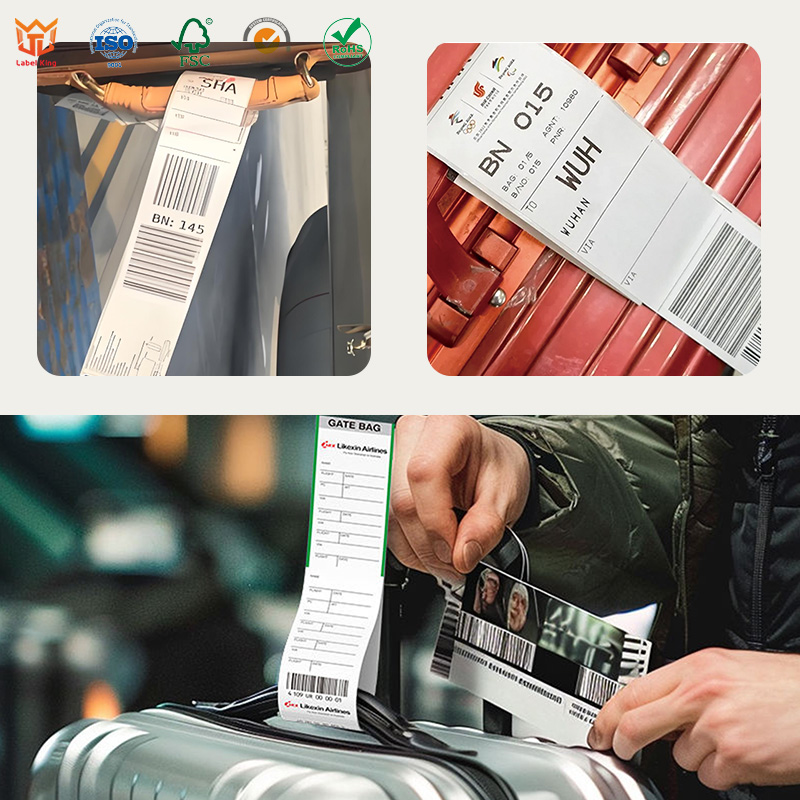
You must select the correct face stock. The industry primarily relies on three distinct categories.
First, consider direct thermal synthetic papers. They utilize a heat-sensitive coating. The printer printhead applies targeted heat. This thermal reaction creates high-contrast black text. You do not need secondary ink ribbons. This simplicity accelerates passenger processing. Manufacturers often apply protective top-coats. These layers repel oils and minor abrasions. Direct thermal materials offer extremely high print speeds. However, vulnerabilities exist. Extreme ambient heat darkens the entire label. Extended ultraviolet exposure fades the printed text.
Second, thermal transfer label materials offer an alternative approach. They rely on external ribbons. The printer melts ink directly onto the face stock. This physical transfer creates a permanent bond. These materials boast exceptional chemical resistance. Archival durability is unmatched. However, they introduce mechanical complexity. Desk agents must replace spent ribbons constantly. This requirement slows down terminal operations. It also increases check-in desk hardware maintenance.
Third, focus on self-adhering and pressure-sensitive technologies. Adhesive-to-adhesive bonding is quite ingenious. Tags stick securely to themselves. They never stick to the luggage handle. They utilize cohesive layers. Pressure activates the bond. Desk agents simply loop the strip and press firmly. Eliminating backing liners gives a massive operational advantage. Linerless self-adhesive label materials reduce solid waste. They also enable much faster application times at automated kiosks. Passengers can tag their own bags seamlessly.
We must evaluate materials using rigorous dimensions. Tensile and tear strength dictate physical survival. Laboratories conduct cross-direction tear testing protocols. They also measure machine-direction resistance. These forces simulate automated baggage handling systems. Conveyor belts routinely snag identification labels. Robotic loaders pull on the loops abruptly. A weak label snaps instantly. You need exceedingly high tear resistance.
An environmental resistance profile is equally essential. Moisture and water pose constant threats. Ground crews often stage carts in heavy rain. Cargo holds experience extreme humidity during long flights. The paper must not dissolve. The adhesive must not lose tackiness. Temperature extremes present another severe challenge. Tarmac conditions regularly drop below freezing. Aircraft then fly to tropical destinations. The adhesive must remain stable across these huge thermal swings. It cannot freeze solid. It cannot melt into a liquid mess.
Printability ensures reliable machine reading. Contrast retention allows fast scanning. Direct thermal coatings must hold sharp edges. Barcodes require stark black-and-white transitions. Blooming blurs these crucial lines. Fading destroys readability entirely. Transit exposes tags to friction and heat. The surface must resist these elements.
Evaluation Dimension | Direct Thermal Synthetic | Thermal Transfer | Required Minimum Standard |
|---|---|---|---|
Tear Strength (MD/CD) | High (Synthetic Base) | Very High (PET Base) | Must withstand 5kg of sudden snag force |
Water Resistance | Excellent | Excellent | Zero delamination after 2 hours of heavy rain |
Print Contrast Retention | Good (Fades under intense UV) | Excellent (Permanent ink bond) | Maintains Grade B barcode readability for 48 hours |
Chemical Repellency | Moderate (Requires heavy top-coat) | High | No smudging upon contact with aviation lubricants |
Airlines operate under strict international frameworks. Regulatory baselines ensure global interoperability. Every tag must adhere to standard IATA specifications. Resolution 740 outlines exact formatting rules. It also details required physical material properties. These rules govern dimensions, layout, and barcode placement. Strict adherence allows seamless transfers between different airline alliances. Non-compliant materials disrupt partner networks instantly.
Security features prevent tampering and theft. Modern constructions incorporate tamper-evident slitting. Manufacturers cut specific void-patterns into the synthetic paper. Someone might try peeling the loop apart. The slitting forces the material to shred itself. This self-destruction prevents malicious actors from swapping luggage destinations. It secures the chain of custody.
RFID integration provides advanced tracking capabilities. Many self-adhesive label materials now accommodate embedded RFID inlays. The industry is moving toward radio frequency tracking aggressively. The challenge lies in precise material construction. The face stock must shield the fragile copper inlay. The adhesive layer cannot cause static interference. The entire construction must prevent physical delamination around the chip. A bent chip ruins the tracking capability entirely.
Great materials fail if terminal printers cannot process them. Hardware alignment requires close attention. You must ensure chosen roll dimensions fit perfectly. Core sizes must match airport kiosk and desk hardware. Brands like Zebra and Custom dominate the aviation space. A misaligned core size halts passenger check-in immediately. The roll simply will not spin freely.
Printhead wear represents a hidden danger. You must assess the abrasiveness of the material top-coat carefully.
Cheaper materials feel rougher to the touch.
They create excessive friction against the thermal printhead.
This friction burns out the heating elements prematurely.
Failed printheads create unreadable white lines through barcodes.
Poor top-coats create massive operational downtime. Desk agents must abandon broken kiosks.
Waste management influences the check-in environment heavily. Traditional silicone liners pile up quickly behind agent desks. Handling liner disposal slows agents down considerably. Slippery liners also create tripping hazards on the floor. Transitioning to linerless self-adhesive configurations solves this completely. It removes the backing paper entirely. This choice creates cleaner counters. It promotes faster processing speeds. Passengers using self-service kiosks appreciate the simplified application process.
Sourcing reliable materials requires a highly structured approach. You should follow specific steps to mitigate operational risks.
Request Technical Data Sheets: Ask manufacturers for detailed specifications. Do not accept glossy marketing brochures. Look for concrete testing metrics. Analyze the caliper thickness carefully. Check the cohesive peel adhesion values. Review the declared service temperature ranges.
Run Sample Testing Protocols: Validate supplier claims yourself. Never commit to bulk minimum order quantities blindly. Run a pilot test in real-world airport environments. Print the samples on your actual terminal kiosks. Stick them onto various luggage materials. Leave them exposed in the rain. Monitor their automated scan rates over a trial week.
Evaluate Supply Chain Resilience: Assess manufacturing capabilities thoroughly. A supplier must maintain consistent quality. Multi-million-roll orders test production limits. Adhesive coating quality often fluctuates in massive batches. Ensure they utilize stringent quality assurance processes. Ask them how they manage raw material shortages.
Consistency matters more than initial peak performance. A single bad batch can disrupt thousands of flights. You must verify their manufacturing redundancy plans.
Durable baggage tags act as a high-stakes consumable. Airlines simply cannot afford material failures on the tarmac. Prioritization must be given to top-coated direct thermal synthetics. You should combine these face stocks alongside pressure-sensitive, self-bonding adhesives. This specific pairing eliminates liner waste entirely. It guarantees rapid application at crowded check-in desks. It ensures barcodes remain perfectly readable throughout complex journeys.
Procurement teams should take immediate action. First, audit your current tag failure rates and identify physical weaknesses. Second, request technical documentation from two or three shortlisted suppliers. Finally, initiate hardware-compatibility testing using your existing terminal printers. Securing better label materials directly improves passenger satisfaction and operational reliability.
A: The industry standard relies heavily on top-coated direct thermal synthetic paper. This material dominates because it balances fast print speeds, excellent tear resistance, and operational simplicity. The top-coat protects the barcode from moisture and mild abrasion. It removes the need for printer ribbons, allowing desk agents to process passengers much faster.
A: They utilize pressure-sensitive, cohesive bonding technology. The manufacturer applies a specialized adhesive formulation to the back of the label. This cohesive layer binds strongly only to itself. When you loop it around a handle and press the ends together, it creates a permanent seal. It never leaves sticky residue on the bag.
A: You must store them in climate-controlled environments. Optimal conditions range between 20 to 25 degrees Celsius. Humidity should remain around 50 percent. You must protect the rolls from direct sunlight and strong ultraviolet exposure. Poor storage causes premature chemical degradation, leading to faded text and weakened adhesive performance before application.
A: Traditional synthetic papers and silicone liners present major sustainability challenges. Recycling facilities struggle to process complex adhesive layers. However, the industry is shifting toward eco-friendly alternatives. Emerging linerless technologies eliminate backing waste entirely. Several manufacturers now develop recyclable synthetic face stocks to reduce terminal waste streams and improve airline sustainability metrics.
