

Views: 0 Author: Site Editor Publish Time: 2026-06-23 Origin: Site


Personal care and daily chemical brands face a difficult packaging dilemma. You must maintain premium brand aesthetics while ensuring containers survive high-moisture, high-friction, and frequent-squeeze environments. Consumers expect pristine packaging from the first pump to the last drop.
Traditional rigid labels often fail under these harsh conditions. Rigid films create wrinkles, peeling edges, and lost brand prestige. Transparent PE Self-Adhesive Film emerges as the preferred substrate for conformable, squeezable packaging. It delivers the highly sought-after "no-label" look flawlessly.
This guide evaluates material capabilities and comparative performance against rigid films. We explore critical technical considerations for procurement teams and packaging engineers. You will learn exactly how to match adhesives and liners to your production reality.
Conformability over Rigidity: Transparent PE excels on squeezable tubes and contoured bottles where rigid materials (like PET) crease or detach.
The "No-Label" Look: Advanced PE films offer high clarity, elevating perceived brand value for clear cosmetic formulations.
Moisture & Chemical Resistance: PE pairs with specialized adhesives to resist degradation from shampoos, oils, and household surfactants.
Implementation Reality: Successful adoption requires matching the adhesive and release liner to your specific high-speed dispensing equipment and bottle surface energy.
Consumers expect packaging to look perfect throughout the product's entire lifespan. However, daily use quickly destroys standard labels. You often notice wrinkles, bubbling, or peeling edges on shower gels and lotions. We call this the squeezability problem. When users squeeze a cosmetic tube repeatedly, rigid films cannot handle the mechanical stress. They flag at the edges or completely delaminate from the surface. Rigid substrates inherently fight the container's natural movement. The material tries to return to its flat state, pulling the adhesive away from the curved bottle.
Bathrooms also create exceptionally harsh environments. Constant humidity and severe temperature fluctuations destroy standard paper labels rapidly. Furthermore, daily chemical products contain harsh chemical compounds. Surfactants, essential oils, and heavy detergents frequently spill onto the packaging exterior. When these liquids seep into the label edges, they break down cheap adhesives. Standard adhesives re-emulsify when exposed to constant moisture, losing their bonding strength entirely.
Over time, you witness severe aesthetic degradation. The adhesive layer turns an unsightly yellow. Edges lift away, allowing dirt and mold to accumulate underneath. Unsightly bubbles form across the primary display panel. When packaging looks degraded, consumers lose trust in the formula inside. Standard self-adhesive label materials simply cannot survive these demanding conditions. You need a specialized packaging solution designed specifically for environmental resilience and repeated physical manipulation.
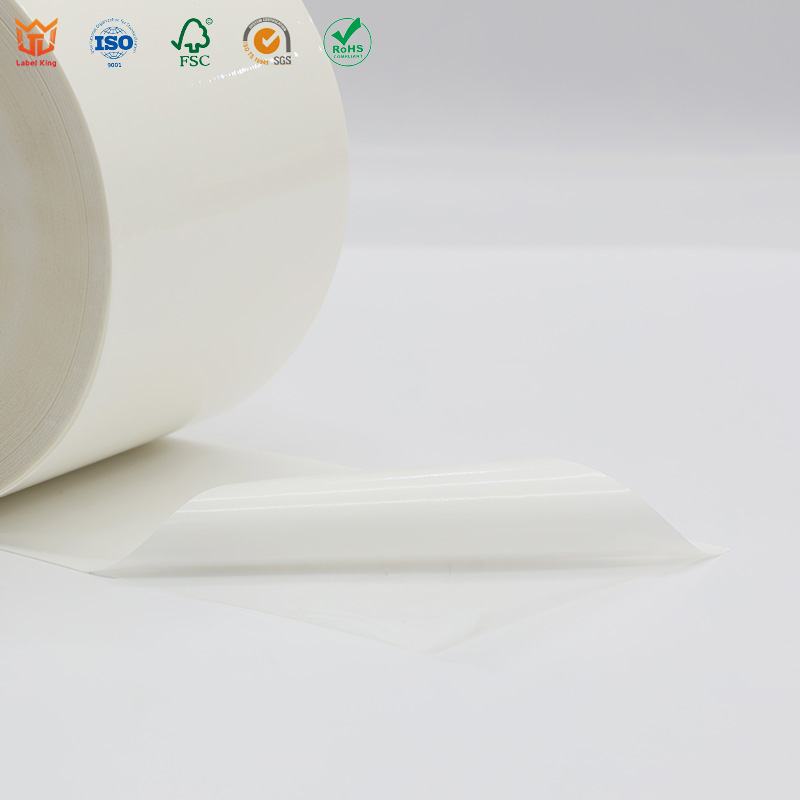
Packaging engineers constantly balance flexibility against optical clarity. We must compare polyethylene (PE) against BOPP (Biaxially Oriented Polypropylene) and PET (Polyethylene Terephthalate) films. Flexibility dictates label performance on squeezable containers. We measure this flexibility in both the machine direction (MD) and cross direction (CD). PE offers exceptional multidirectional flexibility. It stretches, bends, and recovers alongside the plastic container. Conversely, PET acts rigidly and resists deformation. BOPP provides only semi-rigid performance. PE therefore stands as the undeniable baseline standard for contoured or squeezable bottles.
Historically, luxury brands chose PET or BOPP to achieve ultra-high clarity. They wanted the packaging to look directly screen-printed. Today, manufacturing advancements have completely closed this visual gap. Modern transparent PE films undergo engineered extrusion processes to achieve near-identical optical properties. You get the highly desired "no-label" aesthetic without sacrificing vital flexibility. Lower haze values ensure the actual product color shines through the label perfectly.
Durability matters significantly during transport, retail display, and daily consumer use. PE provides robust mechanical tear resistance. Furthermore, the global packaging industry is rapidly shifting toward mono-material structures. Brands increasingly pair PE labels alongside PE bottles. This strategy streamlines post-consumer recycling processes. Sorting facilities no longer need to separate incompatible label plastics from the bottle resin. It improves overall sustainability metrics and supports a circular economy.
Material Feature | Transparent PE | BOPP | PET |
|---|---|---|---|
Flexibility (MD/CD) | Excellent (Highly Conformable) | Moderate (Semi-Rigid) | Poor (Highly Rigid) |
Squeezability | Superior (No edge flagging) | Fair (Prone to creasing) | Fails on soft tubes |
Optical Clarity | High (Advanced "No-Label" look) | Ultra-High | Ultra-High |
Recyclability Focus | Ideal for PE bottle mono-material | Requires separation from PE/PET | Ideal for PET bottle recycling |
Different product formulations require distinct functional packaging characteristics. We generally see these applications fall into two primary categories across the personal care sector.
Premium beauty brands demand flawless visual presentation. Clear serums, expensive face washes, and soft-touch squeeze tubes rely on perfect transparency. The label substrate must completely disappear against the container surface. To achieve this optical illusion, engineers pair PE film with ultra-clear acrylic adhesives. These premium adhesives must remain completely non-yellowing over a multi-year shelf life. The final result successfully mimics direct-to-bottle screen printing. It elevates the perceived brand value significantly. By choosing transparent film, you avoid the high setup costs, slow lead times, and massive minimum order quantities traditionally associated with actual screen printing.
Household and daily chemical products face much rougher handling. Shampoos, shower gels, liquid detergents, and heavy-duty cleaners require intense functional durability. Brand aesthetics remain important, but physical resilience takes absolute priority. You must specify highly water-resistant adhesive formulations here. Showers expose labels to constant, direct water streams. Strong initial tack is equally crucial. Many brands manufacture their containers from High-Density Polyethylene (HDPE) or standard PET. These specific plastics possess naturally low surface energy. Standard adhesives struggle to grip them. Engineers must select aggressive adhesive formulations to ensure permanent bonding throughout the product lifecycle.
Procurement teams need strict frameworks to evaluate label materials properly. You cannot simply order a generic roll of film. Successful high-speed implementation requires careful specification of four critical components. Let us break down these technical criteria.
Adhesive Selection: You must choose between emulsion acrylic and solvent acrylic adhesives. Emulsion acrylics provide standard clarity and good moisture resistance for basic applications. They are highly cost-effective. However, solvent acrylics deliver premium optical clarity and the absolute highest chemical resistance. If your product contains aggressive essential oils or strong surfactants, solvent acrylics are mandatory to prevent delamination.
Release Liner Specifications: The release liner impacts both dispensing speed and optical clarity. Glassine liners offer a cost-effective solution for standard automatic dispensing. However, the slightly textured surface of glassine imprints onto the adhesive layer. For the ultimate "no-label" look, you must specify PET release liners. PET liners keep the adhesive glass-smooth, maximizing transparency. They also resist snapping during ultra-high-speed automatic dispensing.
Thickness & Gauge: You must frame the decision between standard and thin gauges. Standard thicknesses (typically 80 to 85 microns) provide easier handling during the printing and conversion process. They offer sufficient rigidity for smooth automatic dispensing. Thinner gauges reduce material consumption and lower shipping costs. However, they demand highly precise tension control on your dispensing equipment to prevent stretching.
Surface Treatment: Polyethylene naturally possesses very low surface tension. Untreated PE rejects printing inks. Detail the necessity of corona treatment or chemical top-coating on the film. These treatments increase the surface dyne level. This ensures high-quality, smudge-free ink adhesion during UV flexo, digital, or screen printing.
Even the highest-quality materials fail if applied incorrectly. Practical experience on the production floor reveals several common pitfalls. Understanding these risks prevents costly packaging recalls.
The first major threat is the "watermark" or bubbling risk. Trapped air ruins the transparent effect entirely. It creates cloudy, uneven patches that resemble watermarks. Rough adhesive layers also cause this exact visual issue. You must optimize applicator squeegee pressures during high-speed dispensing to push out micro-bubbles. As mentioned previously, utilizing a PET release liner severely mitigates this risk. It ensures the adhesive layer remains perfectly smooth prior to application, allowing for perfect wet-out against the bottle.
Surface energy mismatch presents another frequent failure point. Never apply labels to highly contoured or low-dyne-level bottles without rigorous testing. Low-surface-energy plastics actively reject standard adhesives. Liquids and glues tend to bead up rather than flow smoothly across the plastic. Always warn your production teams about changing bottle resin suppliers. You must conduct thorough adhesive testing beforehand. Match the specific adhesive tack formulation to your precise bottle material.
Finally, improper storage ruins perfectly good material. You must outline strict storage requirements for transparent PE film. Store material rolls in climate-controlled environments. High warehouse heat causes adhesive cold-flow. This means the glue literally oozes out the sides of the roll, causing layers to stick together. Severe temperature swings also cause the plastic film to shrink. Shrinkage ruins print registration before the material even reaches the application line. Strict climate control prevents catastrophic conversion failures.
Transparent PE is not merely a decorative label material. It acts as a highly functional component of your overall packaging architecture. It perfectly balances high-end aesthetics with necessary physical resilience. When sourced and applied correctly, it survives intense bathroom environments, chemical spills, and continuous squeezing while maintaining a premium "no-label" appearance.
Buyers should adopt a strict shortlisting logic. Always advise your procurement teams to request sample rolls specifically matched to your final bottle material. Do not rely on paper specifications alone. Conduct physical 48-hour water bath tests and aggressive squeeze tests in your own facility. Verify that the adhesive withstands your specific product formulation.
Take proactive steps to upgrade your packaging performance today. Download detailed technical data sheets (TDS) from your material supplier. Contact your packaging engineering team to discuss custom adhesive formulation recommendations tailored precisely to your production line.
A: In standard 48-hour water bath tests, PE performs exceptionally well. Performance heavily relies on the adhesive layer, but PE's flexibility plays a crucial role. It stretches alongside the bottle during handling, preventing micro-gaps from forming at the edges. This physical conformity stops water ingress. Conversely, BOPP acts rigidly. It often lifts slightly at the edges when squeezed, allowing water to penetrate and rapidly degrade the adhesive.
A: Yes. This highlights a major advantage within current mono-material packaging trends. Modern recycling facilities can process PE labels alongside PE and HDPE bottles efficiently. Facilities utilize wash-off adhesives that separate during hot caustic washes. Using compatible plastics means the entire container can be ground and reprocessed together, which streamlines sorting and improves recycled resin quality.
A: Cloudiness typically results from three combined factors. First, highly textured bottle surfaces trap microscopic air pockets. Second, improper dispensing tension or low squeegee pressure fails to evacuate trapped air. Third, adhesive smoothness impacts clarity significantly. If your converter utilized a standard glassine liner, the adhesive retains a textured pattern. Switching to a PET release liner ensures a glass-smooth adhesive layer, restoring optical clarity.
A: Yes, it is effectively mandatory. Untreated polyethylene naturally exhibits extremely low surface tension, often falling below 32 dynes. Standard printing inks will not bond to this surface. You must employ chemical top-coating or inline corona treatment before printing. This raises surface energy, ensuring strong, permanent ink adhesion for UV flexo, screen, or digital printing methods.
