

Views: 0 Author: Label king Publish Time: 2026-03-03 Origin: Site


In today's packaging and label manufacturing industry, material selection directly impacts product presentation, durability, and functionality. Among the various available materials, Synthetic Paper has emerged as a highly adaptable solution favored by numerous sectors due to its excellent comprehensive properties. This material offers outstanding tear resistance, water resistance, chemical corrosion resistance, and good printability, enabling high-definition, vibrant printing results. Consequently, it is widely used in food and beverage, cosmetics, pharmaceuticals, logistics, and industrial products.
Unlike traditional paper, Synthetic Paper combines the print quality of paper with the physical strength of plastic materials. It maintains label integrity and clarity even in challenging environments such as humidity, grease, and temperature variations. Furthermore, with growing environmental awareness, recyclable grades of Synthetic Paper are increasingly becoming a key option for brands implementing sustainable packaging strategies.
This article systematically analyzes the core characteristics and practical advantages of Synthetic Paper, assisting manufacturers, designers, and brand owners in understanding its value. This enables more informed and forward-thinking mterial choices in packaging and label design.

Material Definition and Structural Features
Synthetic Paper is primarily made from polypropylene and manufactured using a biaxial orientation process. This process aligns the polypropylene film molecules in both the machine and transverse directions, significantly enhancing the material's mechanical strength, dimensional stability, and surface smoothness. As its substrate is a polymer, Synthetic Paper is not only water-resistant, oil-resistant, and chemically resistant but also possesses tear and puncture resistance absent in ordinary paper.
Comparison with Traditional Paper and Other Materials
Property | Traditional Paper | Synthetic Paper |
Tear Resistance | Low | Very High |
Water/Moisture Resistance | Weak | Excellent |
Chemical Resistance | None | Good |
Print Precision | Medium | Supports High Resolution |
Environmental Resilience | Easily Affected | Emperature & Moisture Resistant |
Recyclability | Recyclable | Partially Recyclable |
As shown in the table, Synthetic Paper surpasses traditional paper in several key performance aspects, making it particularly suitable for applications demanding high label durability and visual quality.
Brief on Production Process
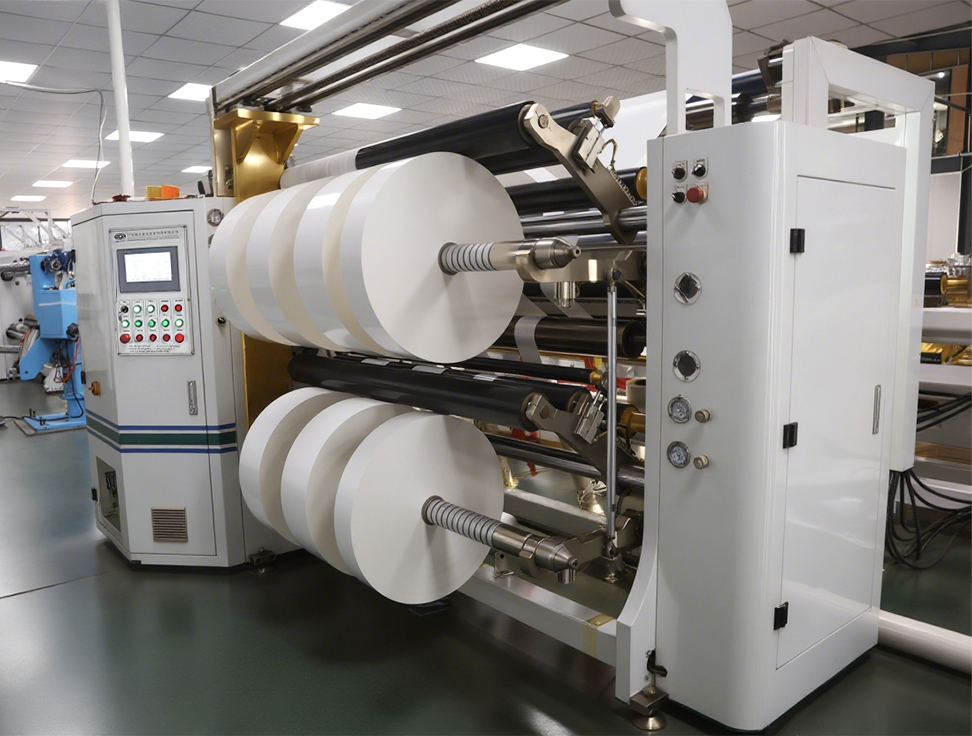
The manufacturing of Synthetic Paper primarily involves melt extrusion, biaxial orientation, surface treatment, and slitting. By precisely controlling the stretch ratio and heat treatment process, the material achieves high consistency in thickness, transparency, and surface texture. It can be further processed into matte, glossy, or special texture finishes to meet diverse customer aesthetic and functional needs.
二、 Analysis of Core Properties
Exceptional Mechanical Properties
Synthetic Paper exhibits high tear resistance, puncture resistance, and abrasion resistance. It is less prone to damage during logistics handling, warehouse stacking, and transportation, effectively reducing identification failures and re-labeling costs caused by label damage.
Comprehensive Environmental Resistance
Water and Moisture Resistance: Does not warp, mold, or peel due to humidity changes, suitable for cold storage food, beverage packaging, and other damp environments.
Hemical Stability: Offers good resistance to acids, alkalis, oils, greases, and common cleaning agents, widely used for labels on daily chemical products and industrial lubricant containers.
Temperature Adaptability: Maintains stable physical properties under high or low-temperature conditions, without compromising adhesion strength or print integrity.
High-Quality Printing and Finishing Effects
Its surface, treated with corona or coatings, is compatible with various printing methods (like offset, flexography, digital printing), enabling vibrant colors and fine detail reproduction. Additionally, Synthetic Paper is suitable for post-processing techniques such as hot stamping, spot UV, and embossing, enhancing visual appeal for brand packaging.
三、 Summary of Application Advantages
Enhances Product Image
High-resolution printing combined with customizable surface textures helps brands create a premium, professional visual identity in a competitive market.
Extends Label Lifespan
High inherent strength and strong weather resistance ensure labels do not fade or damage throughout the product's storage, transportation, and usage lifecycle, protecting brand reputation and user experience.
Supports Sustainable Development
Recyclable grades of Synthetic Paper are now available on the market. When paired with eco-friendly inks and processes, they can help brands respond to green packaging initiatives and enhance their corporate environmental image.
Cost-Effectiveness and Multi-Scenario Applicability
Despite its superior performance, Synthetic Paper remains cost-effective in large-scale applications. Its high versatility across different industries and packaging types helps businesses consolidate supply chains and reduce procurement and management complexity.
Industry Category | Application Examples | Key Needs Met |
Food & Beverage | Water bottle labels, condiment packaging | Waterproof, low-temperature resistance, secure adhesion |
Cosmetics & Personal Care | Serum bottle labels, face mask packaging | High-gloss print, comfortable tactile feel |
Pharmaceuticals & Healthcare | Medicine boxes, medical device labels | Alcohol wipe resistance, long-lasting information clarity |
Industrial & Logistics | Component identification, warehouse shelf labels | Tear resistance, abrasion resistance, outdoor weather resistance |
High-End Consumer Goods | Wine labels, gift box labels | Premium visual appeal, suitable for complex processes |
Synthetic Paper supports various processing methods like die-cutting, perforating, and folding, allowing for more creative label and packaging shapes. Environmentally, its durability reduces material waste from label replacements at the source. Some grades are already compatible with polypropylene recycling streams, offering a viable path for the circular economy.
Synthetic Paper, as a comprehensive and widely applicable label and packaging material, demonstrates significant advantages not only in physical strength, environmental resistance, and print performance but is also increasingly meeting modern brand requirements in terms of sustainability. Correct selection and use of this material can help enterprises ensure functional reliability while shaping a more distinctive and competitive product appearance.
If you need to learn more about model selection, custom sampling, or supply chain support for Synthetic Paper, please feel free to contact professional material suppliers. We can provide technical advice and product services tailored to your project needs.
