

Views: 0 Author: Site Editor Publish Time: 2026-07-02 Origin: Site


In high-volume warehouse operations, barcode unreadability creates severe operational hurdles. Label degradation directly translates to massive supply chain bottlenecks. You lose substantial revenue when automated scanners fail to read fading labels. Direct thermal paper suffices for fast, short-term logistics. However, long-term asset tracking demands highly robust materials. Harsh storage environments quickly destroy standard paper tags. You need industrial-grade substrates to survive these demanding conditions. Transitioning to a PET Label Sticker Jumbo Roll ensures maximum barcode durability. It effectively safeguards your vital tracking data. Yet, this strategic shift requires careful technical evaluation. You must assess adhesives, top-coatings, and converter compatibility meticulously. This guide breaks down the essential technical criteria you need. We explore commercial factors for sourcing high-yield polyester materials. You will learn how to match face stocks to specific environments. We also cover actionable strategies to optimize high-speed conversion. Applying these exact insights prevents costly operational downtime.
Substrate Superiority: PET (Polyester) outperforms paper and PP in chemical resistance, tear strength, and extreme temperature tolerance, making it ideal for permanent warehouse rack and asset barcode labels.
Adhesive Matching: Selecting the correct adhesive (e.g., solvent acrylic for cold storage) is as critical as the face stock when evaluating self-adhesive label materials.
Converter Efficiency: High-quality jumbo rolls minimize web breaks and adhesive bleed during high-speed die-cutting, directly impacting the converter's bottom line.
Warehouses process thousands of rapid scans daily. Barcode failure disrupts this automated flow instantly. Standard paper barcodes often scuff during routine forklift handling. They fade rapidly under intense warehouse UV lights. Humid environments cause them to peel and fall off racks. These cascading failures force workers to manually key in tracking data. Manual entry drastically increases human error rates. Relabeling pallets slows down dispatch timelines considerably. You lose valuable operational hours simply repairing damaged tracking tags.
Polyester offers a clear, robust solution to these problems. We measure PET durability across multiple extreme stress factors. It strongly resists heavy abrasion from rough pallet jacks. Moisture cannot penetrate its dense synthetic surface. Industrial solvents and chemical cleaning agents do not dissolve it. It performs flawlessly in freezing cold storage facilities. It also survives high-heat zones located near heavy machinery. You gain absolute peace of mind regarding label integrity.
To achieve this permanence, printer compatibility remains critical. PET inherently requires thermal transfer printing. You must use specialized resin ribbons for optimal image permanence. This establishes a strict operational baseline for end-users. Direct thermal printers simply cannot print on polyester materials. Resin ribbons fuse ink directly into the PET top-coating via heat. This chemical bond creates a totally scratch-proof barcode. You guarantee long-term readability across all demanding warehouse zones.
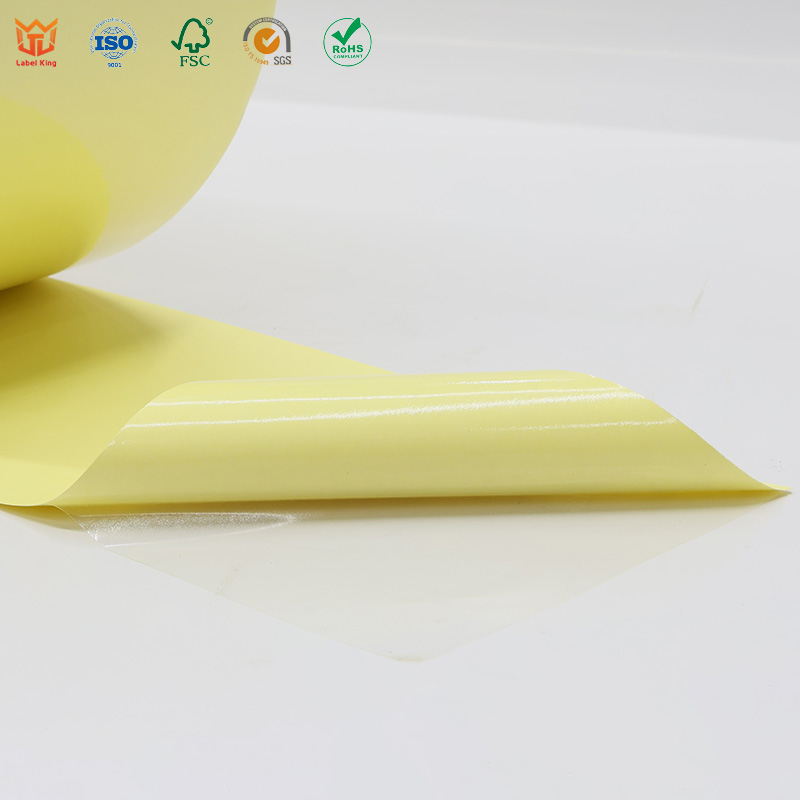
Sourcing industrial self-adhesive label materials requires examining multiple distinct layers. We call this complex construction the "sandwich" structure. Each specific layer profoundly impacts final tag performance.
First, consider the face stock thickness carefully. Standard PET faces usually range from 25μm to 50μm. Thicker films resist aggressive tearing much better. Surface finish also plays a vital operational role. You must deliberately choose between matte and glossy options. Glossy surfaces sometimes reflect warehouse scanner lasers poorly. This unexpected reflection drastically lowers initial read rates. Matte finishes usually provide superior barcode contrast. Finally, evaluate the chemical top-coating quality. Good top-coatings ensure strong ribbon anchorage during the printing process. They prevent the printed ink from flaking off later.
The adhesive securely anchors the label to your critical assets. You must match it precisely to the physical environment. Water-based acrylic adhesives suit standard indoor warehouse conditions well. They bond firmly to clean, flat metal or smooth plastic. Solvent and hot-melt adhesives handle significantly tougher challenges. Use them for rough, porous surfaces like corrugated boxes. They also excel in challenging cold-chain logistics. You must also evaluate specific bond strength requirements. Determine if you need removable or highly permanent adhesives. Permanent tracking always requires specialized high-tack formulations.
The liner protects the sticky adhesive before final application. Converters typically choose between glassine and PET liners. Glassine offers a highly cost-effective, standard industry solution. PET liners provide truly unmatched tensile strength. Consistent caliper (thickness) remains absolutely vital here. Irregular liner thickness causes dangerous die-strikes. The die might cut too deep and sever the liner completely. High-quality liners actively prevent these matrix stripping failures. They keep conversion machine speeds exceptionally high.
Selecting the wrong substrate ruins your labeling strategy. We must compare leading materials objectively.
Fast-moving consumer goods rely heavily on standard paper. It works perfectly for short-life shipping tags. However, paper has very strict physical limitations. Heat and continuous UV exposure turn direct thermal paper black. Moisture quickly degrades semi-gloss paper faces. It lacks the physical durability needed for long-term storage applications.
PP offers excellent physical flexibility. It wraps easily around severely curved surfaces. Many standard consumer product labels use PP materials. Yet, PP falls noticeably short in harsh industrial environments. It features much lower temperature resistance compared to polyester. PP films can also stretch badly under tension. This unwanted stretching permanently distorts printed barcodes. Scanners then fail to read the skewed lines.
Polyester heavily dominates rigid industrial applications. It fits perfectly on heavy-duty warehouse racks. Electronics tracking and outdoor storage rely heavily on PET. Chemical drums require its superior solvent resistance. The main limitation is a notably higher unit cost. Furthermore, PET remains quite physically rigid. Its stiff nature makes it entirely unsuitable for tight-radius applications. It will inevitably flag or peel on small, curved vials.
Material Type | Best Application Areas | Key Limitations | Temperature Resistance |
|---|---|---|---|
Direct Thermal Paper | Fast-moving consumer goods, short-life shipping labels | Fades under UV light; highly vulnerable to moisture | Low (Avoid high heat) |
Polypropylene (PP) | Standard product labeling, tightly curved surfaces | Can stretch under tension; distorts printed barcodes | Moderate |
Polyester (PET) | Rigid warehouse racks, electronics, chemical drums | Higher unit cost; too rigid for small curved vials | Extremely High |
High-speed label conversion demands highly precise technical specifications. Poorly wound master rolls cause immediate press downtime. We must evaluate several distinct manufacturing metrics rigorously.
Dimensional Tolerances: Converters need optimal press utilization to remain profitable. Standard industry roll widths include 1020mm and 1070mm. Lengths typically span from 2000m to 6000m. Precise slit edges actively prevent web wandering. This precision ensures clean cuts across the entire web width.
Core Dynamics: Core size directly impacts tension control. Presses utilize standard 3-inch or robust 6-inch cores. Manufacturers construct them from heavy paper or solid plastic. Six-inch cores successfully prevent inner-wrap wrinkling on massive rolls. Steady tension guarantees smooth, uninterrupted slitting operations.
Defect Management: Material manufacturers must declare acceptable splice limits clearly. Too many taped splices disrupt automated printing processes. Edge straightness remains absolutely non-negotiable. You must prevent aggressive adhesive oozing completely. Bleeding edges literally glue roll layers together during transit.
Storage Requirements: Applied adhesives possess strict, unforgiving shelf lives. Transparent climate control guidelines remain essential. You must manage facility temperature and ambient humidity closely. Proper storage perfectly preserves original adhesive tack before final conversion. It stops the adhesive from curing prematurely on the roll.
Evaluating potential suppliers carefully minimizes your production risks. You simply cannot afford highly inconsistent raw materials. Focus your factory audits on three critical operational pillars.
Vet potential manufacturers very carefully. Ask for updated ISO certifications upfront. RoHS and REACH compliance remain critically important. You desperately need these certifications for electronics and strict European markets. Demand detailed, consistent batch-to-batch testing records. These crucial documents prove the factory maintains strict quality control over every production run.
Standardized materials rarely fit every unique project perfectly. Evaluate a supplier's engineering flexibility closely.
Can they apply custom coat weights for specialized adhesives?
Do they provide non-standard, highly specific slitting widths?
Can they adjust top-coating chemistry for unique resin ribbons?
Will they develop customized face stocks for extreme temperatures?
Never buy a massive full container blindly. Establish a highly rigorous testing protocol first. Request smaller sample rolls before major financial commitments. A standard 100m trial roll provides enough material. It allows comprehensive press trials. Test the actual die-cutting performance thoroughly. Observe waste matrix removal at maximum machine speeds. Verify resin ribbon compatibility on your specific thermal transfer printers. Only commit to large MOQ container loads after passing these rigorous tests.
Sourcing a high-quality PET Label Sticker Jumbo Roll remains a highly strategic decision. It practically guarantees long-term supply chain reliability. You successfully balance raw material expenses against massive operational security. Fail-proof barcodes keep your automated warehouse moving efficiently. High-performance self-adhesive label materials eliminate scanning bottlenecks entirely. They proactively stop revenue leaks caused by tracking errors.
Start by thoroughly auditing your current warehouse environment. Measure specific temperature ranges across your entire facility. Identify the exact surface types you must tag. Note your existing automated scanner and thermal printer technologies. Next, request detailed technical data sheets from qualified manufacturers. Secure material samples perfectly tailored to your unique environment. Run extensive pilot tests to confirm actual field performance. Make solid data-driven decisions to aggressively protect your tracking infrastructure.
A: A standard roll typically lasts 12 months before conversion. You must store it under carefully controlled climate conditions. Maintain temperatures between 20°C and 25°C. Keep relative humidity around 50%. Improper storage accelerates adhesive degradation and causes severe edge bleeding. Always follow the manufacturer's technical data sheet for specific guidelines.
A: No. Direct thermal printers use heat-sensitive paper and do not utilize ribbons. PET materials strictly require thermal transfer printers. You must pair them with high-quality resin ribbons. The printer's heat head melts the resin directly into the polyester top-coating. This creates a permanent, scratch-resistant, and chemical-proof image.
A: A PET liner offers vastly superior tensile strength compared to glassine. It rarely breaks under high-speed press tension. This minimizes costly web breaks and reduces overall machine downtime. It also provides a smoother surface for adhesive coating. However, PET liners carry a noticeably higher upfront cost than standard glassine alternatives.
A: Yes, the synthetic polyester face stock is 100% waterproof. It will not absorb moisture or disintegrate when completely wet. However, overall moisture resilience depends heavily on the adhesive layer. You must select a specialized marine-grade or solvent-based adhesive if the label faces continuous submersion or heavy industrial wash-downs.
