

Views: 0 Author: Site Editor Publish Time: 2026-06-29 Origin: Site


Premium product packaging requires labels communicating brand quality instantly. They must also survive rigorous supply chain and environmental conditions. Brands often face a tough trade-off here. You want high aesthetic appeal, like striking metallic finishes. Yet you also need technical durability, meaning strong tear, moisture, and chemical resistance. Finding a single substrate delivering both is traditionally challenging.
Evaluating Silver PET (Polyester) against other options ensures your packaging maintains its integrity. From the manufacturing floor to the end-user's hands, your branding must stay pristine. This article explores how polyester performs under intense physical stress. We break down different metallic finishes and discuss common implementation risks. You will learn exactly how to choose the right materials to safeguard your brand.
Silver PET label material offers superior dimensional stability and tear resistance compared to standard paper or vinyl substrates.
The material is highly resistant to water, oils, and chemicals, making it ideal for cosmetics, electronics, and premium beverages.
Successful implementation requires matching the PET face stock with the correct adhesive type (e.g., acrylic for rigid surfaces) and printing technology (e.g., resin ribbons for thermal transfer).
Because PET is a rigid film, it is strictly recommended for rigid containers (glass, metal, hard plastics) rather than squeezable tubes.
Packaging acts as your silent salesperson on the retail shelf. Label failure directly degrades perceived brand value. Curling edges, faded ink, or scuffed barcodes tell consumers a negative story about your product quality. Worse, scuffed barcodes frequently lead to expensive retail chargebacks. Poorly performing labels also cause elevated product return rates. Solving this business problem requires upgrading your base substrate.
Polyester delivers immense structural advantages. It is inherently robust and built for demanding environments. Unlike standard paper, it does not turn to mush when exposed to water or condensation. Unlike vinyl (PVC), it does not shrink, stretch, or warp under high heat. Integrating Silver PET Label Material prevents the catastrophic failures plaguing cheaper materials. You gain peace of mind knowing the label stays exactly where you placed it.
Beyond raw strength, the aesthetic impact remains undeniable. A metalized polyester finish mimics expensive foil stamping. It also replicates the look of direct-to-glass printing. You achieve these high-end looks at a fraction of the cost. The material runs efficiently on modern label presses, offering greater scalable efficiency. You elevate your brand presentation without slowing down your production lines.
Choosing premium packaging materials requires rigorous performance testing. You must evaluate how the substrate handles daily abuse. Real-world environments introduce moisture, chemicals, temperature swings, and friction.
The chart below summarizes how polyester compares to other common self-adhesive label materials across critical stress factors.
Material Type | Tear Resistance | Thermal Stability | Chemical Resistance | Flexibility |
|---|---|---|---|---|
Standard Paper | Low | Low | Low | High |
Vinyl (PVC) | Medium | Medium | Medium | Very High |
Silver PET | Very High | High (-40°C to +150°C) | High | Low (Rigid) |
Let us explore these evaluation dimensions in deeper detail.
Polyester films do not absorb moisture. This makes them ideal for humid bathroom environments. Shampoos, conditioners, and luxury cosmetics require labels surviving daily showers. Refrigerated storage presents another challenge. Premium beverages often experience heavy condensation when moving from cold storage to room temperature. Polyester prevents the bubbling and peeling commonly seen in these scenarios.
Furthermore, it resists aggressive chemical degradation. Essential oils frequently leak down dropper bottles. Industrial solvents and mild acids routinely spill in manufacturing settings. Polyester acts as a barrier. It stops these substances from eating through the face stock and destroying your branding.
Temperature fluctuations destroy weak labels. Polyester maintains strong adhesion across extreme temperature ranges. Depending on the specific adhesive paired with it, the material withstands environments from -40°C up to +150°C. This broad operational window is crucial.
During heat-intensive shipping or storage, inferior films stretch or warp. This causes label edge-lifting. Polyester holds its shape perfectly. Whether your product sits in a baking delivery truck or a freezing warehouse, the label remains completely intact.
You cannot tear a high-quality polyester label by hand. It provides excellent dimensional stability under physical duress. This rigidity protects vital regulatory text during transit. Products constantly rub against cardboard dividers or other bottles in shipping cartons. Polyester prevents severe abrasion. Your critical barcode information remains perfectly readable, preventing logistical delays and retail penalties.
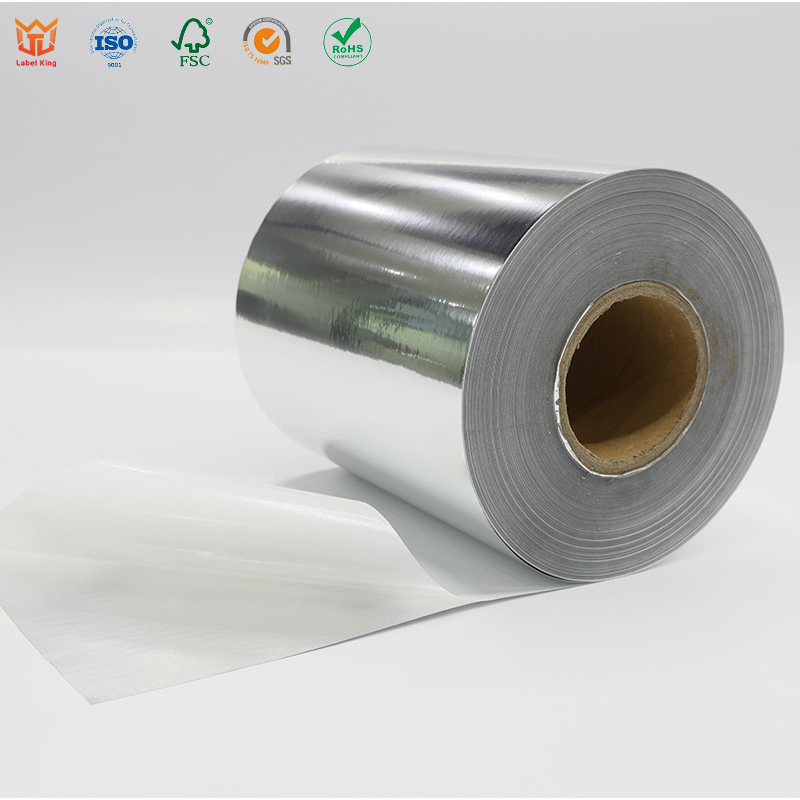
Visual presentation dictates consumer perception. Polyester comes in several distinctive metallic finishes. Each finish serves a specific psychological and functional purpose. You must align the visual characteristics with your brand identity and scanning requirements.
A high-gloss finish creates an immediate luxury statement. It features a mirror-like, highly reflective surface. This option excels in drawing consumer attention on crowded retail shelves.
Best For: Luxury health and beauty products, premium spirits, and high-contrast promotional labeling. It highlights bold typography and rich color gradients beautifully.
Considerations: Highly reflective surfaces sometimes confuse retail barcode scanners. The glare bounces scanner lasers away from the detector. You must use specific top-coatings to ensure proper ink anchorage. We strongly recommend printing solid white blocks behind barcodes to guarantee easy scanning.
Matte and brushed finishes offer a highly sophisticated, muted aesthetic. They mimic the appearance of machined steel or brushed aluminum. This provides an industrial yet premium feel.
Best For: Electronic appliance rating plates, automotive parts, asset tags, and modern, minimalist cosmetic packaging. It signals precision and professional-grade quality.
Considerations: This finish significantly reduces surface glare. It makes fine-print regulatory text much easier to read under bright retail lighting. It also hides minor surface scratches better than high-gloss alternatives.
When selecting a finish, follow this simple numbered evaluation process:
Analyze the retail lighting environment where consumers will view the product.
Determine the size and placement of critical scanning barcodes.
Match the metallic texture to your overarching brand messaging (flashy versus understated).
Selecting a great substrate represents only the first step. Execution dictates ultimate success. Brands frequently encounter printing and application hurdles. Understanding these implementation risks prevents costly manufacturing delays.
Not all materials accept ink equally. Standard inks easily bead up or wipe off raw plastic films. Silver polyester typically requires a specialized chemical top-coat. This coating prepares the surface for UV inkjet, flexographic printing, or laser printing. It acts as an anchor, locking the pigment into place permanently.
Variable data printing presents its own challenges. Many facilities use Thermal Transfer (TT) printing for batch numbers or expiration dates. If you use TT printers, high-durability resin ribbons are absolutely mandatory. Standard wax ribbons will instantly smudge on polyester surfaces. Wax needs a porous surface like paper to absorb properly. Resin melts and fuses directly to the plastic film, creating a permanent bond.
Adhesive failure ruins beautiful packaging. You must match the glue to the container material. Surface tension heavily dictates adhesive performance.
Standard acrylic adhesives work exceptionally well for high-surface-energy (HSE) materials. Glass bottles and smooth metal cans possess high surface energy. The adhesive wets out quickly, forming a permanent, aggressive bond.
However, low-surface-energy (LSE) plastics act differently. High-Density Polyethylene (HDPE) and textured plastics repel standard acrylics. Applying standard glue to LSE plastics results in rapid peeling. You must specify a specialized heavy-coat weight adhesive. Rubber-based adhesives often perform better on these challenging, slippery surfaces.
Every material possesses a physical limitation. For polyester, that limitation is rigidity. This rigidity provides excellent tear resistance. However, it creates a major application risk on flexible packaging.
Applying rigid labels to squeezable tubes causes instant failure. The tube bends, but the label refuses to flex. This results in severe "flagging," where the edges aggressively lift away from the container. It also causes deep, ugly creasing across the face stock. If you use highly contoured, tapered, or squeezable containers, you must avoid polyester entirely. Polyethylene (PE) remains the correct alternative for flexible packaging scenarios.
Sourcing industrial materials requires rigorous vetting. You cannot rely on marketing claims alone. Establishing a strict shortlisting logic protects your production timeline. It also ensures consistent quality across multiple print runs.
Start by requesting Technical Data Sheets (TDS). A TDS provides the exact engineering specifications of the material. Verify the actual caliper (thickness) of the face stock. Check the specific adhesive tack values. You must also evaluate the release liner specifications. High-speed automatic dispensing machines often require a PET liner to prevent web breaks. Glassine liners work fine for slower, semi-automatic applications.
Next, verify compliance and certifications. Global distribution networks demand strict regulatory adherence. For electronics and appliances, ensure the material is RoHS and REACH compliant. If the product plugs into a wall, you likely need UL-recognized label constructions. Ask your supplier for these certificates upfront.
Finally, mandate rigorous sampling and environmental testing. Never bypass the prototyping phase. Ask your converter for blank roll samples. Run these samples through your specific label applicators. Watch for dispensing errors or tension issues. Apply them to your actual product containers. Then, subject them to simulated end-use environments. Conduct a 48-hour water submersion test. Place them in a heat-chamber. Real-world testing reveals vulnerabilities before you commit to a massive production run.
Silver PET label material successfully bridges a difficult packaging gap. It combines high-end visual appeal with genuine industrial-grade durability. By utilizing this substrate, you actively safeguard your brand equity against supply chain hazards and harsh consumer environments.
Your ultimate success depends on holistic material planning. Prioritize substrate compatibility and accurate printing methodology over pure unit cost. A cheaper label becomes incredibly expensive if it causes product returns or retail chargebacks.
To move forward, take these action-oriented next steps:
Identify the exact chemical composition of your product containers (e.g., Glass, PET, HDPE).
Consult with a specialized label converter to discuss your specific thermal and moisture requirements.
Request physical material samples and TDS documentation.
Conduct internal environmental testing using your exact products before placing a commercial order.
A: No. PET is a rigid material. Repeated squeezing will cause the label to crease or detach. For squeezable containers, metalized Polyethylene (PE) or Polypropylene (BOPP) is recommended.
A: You can print on Silver PET using standard commercial flexographic or digital label presses, provided the material has the correct top-coating. For on-demand thermal transfer printing, you must use a full-resin ribbon.
A: Yes, the PET face stock is 100% waterproof. However, the overall waterproof performance depends entirely on pairing it with a marine-grade or water-resistant adhesive.
A: While both are durable plastic films, PET offers higher temperature resistance, superior tensile strength, and better long-term dimensional stability compared to BOPP (Biaxially Oriented Polypropylene), making PET better suited for harsh environments or long-lifecycle products.
