

Views: 0 Author: Site Editor Publish Time: 2026-06-22 Origin: Site


Applying standard labels to curved, tapered, or soft-squeeze containers often results in edge lifting, bubbling, or creasing. These physical defects instantly degrade shelf appeal and damage consumer trust in the product. Squeezable and contoured packaging inherently demands high-conformability materials. Rigid plastics or standard papers simply cannot absorb the constant mechanical stress applied to these distinct geometries over time.
You need a reliable specification strategy to prevent packaging failures in the field. This guide provides a comprehensive technical and commercial framework for navigating these unique packaging challenges. It helps you precisely evaluate and specify the correct self-adhesive label materials for demanding applications. We will explore the physics of material failure, guide you through complex sizing calculations, and demonstrate how properly engineered solutions ensure structural integrity, application efficiency, and long-term end-user durability.
Material Dynamics: PE (Polyethylene) offers superior multidirectional flexibility compared to rigid PP or BOPP, making it the industry standard for squeezable tubes and curved containers.
Failure Mitigation: Proper specification of face stock thickness, adhesive type, and liner significantly reduces application defects like tunneling and edge flagging.
Sizing Realities: Tapered and complex compound curves require precise mathematical sizing and overlap calculations, not standard die-cuts.
Sustainability Advantage: Utilizing a PE label on a PE container creates a "mono-material" package, streamlining the recycling stream without removing the label.
Label failure translates directly into financial losses and brand dilution. When products reach the retail shelf with peeling edges or bubbled graphics, consumers often perceive the contents as cheap or compromised. Brands face expensive returns, mandatory product rework, and diminished shelf appeal. Resolving these issues requires understanding the physical forces acting upon the packaging surface.
The most common defect on tight circumferences is edge lift, commonly known as flagging. This occurs due to the inherent "memory" of rigid materials. When manufacturers apply standard paper or rigid films like PP (Polypropylene) to a curved bottle, the material physically resists the curve. It constantly attempts to return to its original, flat state. Over time, this mechanical tension overcomes the adhesive bond. The edges release from the container, standing straight out like a flag.
Soft-touch packaging introduces another layer of mechanical stress. Consumers repeatedly squeeze and crease cosmetic tubes, shampoo bottles, and condiment dispensers. Each squeeze stretches the packaging material outward and compresses it inward. Standard films easily crack, wrinkle, or delaminate under this continuous flex. Successful labeling here requires materials engineered with exceptional elongation properties. They must seamlessly stretch and retract alongside the container walls without permanent distortion.
Surface energy acts as the final physical barrier to successful adhesion. Many modern squeezable containers utilize Low Surface Energy (LSE) plastics, such as High-Density Polyethylene (HDPE). These LSE surfaces inherently resist adhesive wetting. The adhesive struggles to flow out and create a strong molecular bond. When you combine an LSE plastic container with a tight curve and a rigid face stock, delamination becomes almost inevitable. You must address these specific surface energy factors during your initial material specification process.
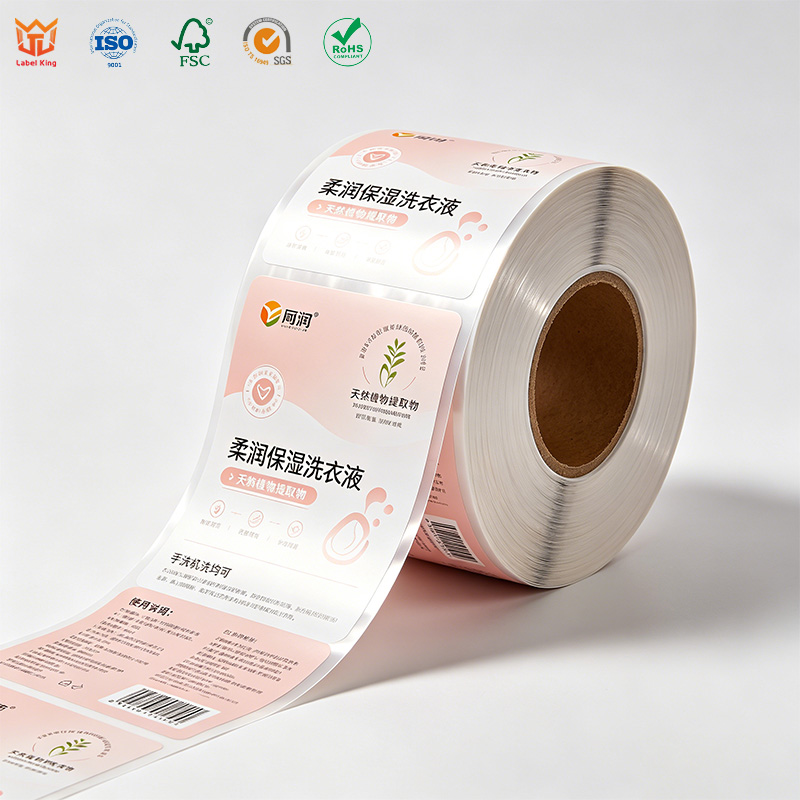
Evaluating packaging components requires matching the physical properties of the face stock directly to the container's behavior. A PE Self-Adhesive Label provides the necessary flexibility for contoured and squeezable designs. Comparing PE to other common polymers clarifies why it remains the industry standard for these demanding applications.
Comparison of Common Label Film Materials | ||||
Material Type | Flexibility / Conformability | Clarity | Primary Application | Performance on Soft Tubes |
|---|---|---|---|---|
PP / BOPP | Low (Very Rigid) | Ultra-High (No-label look) | Rigid glass or flat plastic bottles | Fails quickly; wrinkles and flags |
PET (Polyester) | Very Low (Stiff) | High | High-heat environments, durables | Fails on tight curves and squeezes |
PE (Polyethylene) | Very High (Stretchy) | Moderate to High | Squeezable tubes, contoured bottles | Excellent; stretches with the container |
Adhesive selection plays a role just as critical as the face stock. You must evaluate the balance between aggressive initial tack and long-term permanent adhesion. Standard adhesives often fail on textured or LSE curved surfaces. Engineers typically specify high coat-weight acrylic adhesives for these situations. A thicker layer of adhesive fills microscopic textures on the container surface. This maximizes contact area and ensures a permanent bond, even when the container repeatedly flexes.
However, performance trade-offs always exist in material science. You should transparently evaluate PE's specific limitations. Because polyethylene is inherently softer, it remains more prone to elongation during high-speed application processes. If application line tension is too high, the label stretches out of shape. Additionally, while clear PE exists, it generally lacks the ultra-clear, "glass-like" transparency of BOPP. Brands seeking an absolute invisible edge on a rigid bottle might prefer BOPP. But for squeezable containers, PE offers the only structurally sound path forward.
Geometrical accuracy dictates the success of your packaging design. Standard rectangular die-cuts fail spectacularly on complex compound curves and tapered containers. When top and bottom radii differ, a rectangular shape cannot wrap evenly around the circumference. Instead, it inevitably spirals downward during application. Preventing this spiraling requires highly specific curved or arced label die-cuts. These arcs perfectly offset the bottle's draft angle.
When engineering full-wrap designs for cylindrical bottles, you must implement the overlap rule. Allowing the material to wrap around the bottle and adhere back onto itself creates a stronger, permanent mechanical lock. Follow these sequential steps to calculate precise sizing:
Measure the True Circumference: Use a flexible measuring tape directly around the widest part of the application zone.
Determine Overlap Width: Add an extra 1/8" to 1/4" (3mm to 6mm) to your measured circumference.
Specify the Under-layer: Ensure the overlapped section does not contain heavy varnishes or laminations. Adhesives bond poorly to slick UV coatings.
Test the Lock: Verify the overlap stays fully flat after a 48-hour cure period.
Dimensional tolerances also require strict mathematical discipline. You must measure the maximum printable height and width carefully. Always keep the edge of your design at least 1/8" away from where the bottle begins to curve inward at the shoulder or taper at the base. Trying to force a straight-edged film over a compound curve guarantees wrinkling. Keep your application zone strictly within the most uniform, flat-cylindrical portion of the bottle geometry.
Bringing a perfectly specified design to the production line introduces a new set of mechanical challenges. You must proactively manage web tension, static buildup, and application pressures to avoid costly machine downtime. Because PE face stock stretches easily, standard tension settings on the labeling line often cause web breaks or image distortion.
Calibrate Tension Control: Reduce machine tension settings compared to rigid PP runs. Utilize servo-driven applicators to maintain precise web handling.
Monitor Release Force: Ensure the liner removes smoothly without pulling too hard on the highly conformable face stock.
Inspect for Distortion: Regularly check applied designs to ensure brand graphics have not stretched horizontally during high-speed runs.
Static electricity frequently plagues production environments. The physical action of peeling the face stock away from the liner generates significant triboelectric charge. This static aggressively attracts ambient dust and micro-particulates from the facility floor. When these particles get trapped under transparent PE film, they create highly visible, unappealing bubbles. You should install active static elimination equipment, such as ionizing bars, directly at the peel point.
Proper wipe-down mechanisms ensure even pressure distribution across the contoured surface. Standard stiff brushes often scratch soft films or fail to expel trapped air effectively. We recommend upgrading your labeling machinery with soft rollers or flexible brush wipers. These tools conform perfectly to the curved bottle surface. They confidently push air pockets outward from the center to the edges, eliminating creases before the adhesive sets.
Finally, always respect proper adhesive curing times. Pressure-sensitive adhesives do not reach ultimate bond strength immediately upon application. They typically require 24 to 48 hours to flow into the container's surface completely. Production teams should never conduct extreme squeeze tests or temperature stress tests immediately off the line. Give the chemistry sufficient time to cross-link and lock onto the LSE plastic before evaluating performance.
Corporate sustainability mandates heavily influence modern packaging specification. Municipal recycling facilities (MRFs) increasingly reject packaging constructed from mixed plastics. A common recyclability bottleneck occurs when brands apply incompatible materials together, such as a PET label onto an HDPE bottle. Near-infrared (NIR) sorting machinery becomes confused by the overlapping resin signatures. As a result, the entire package often ends up diverted to a landfill instead of being processed for reuse.
Adopting a mono-material strategy directly solves this critical compliance issue. By pairing a PE face stock with a PE container (like HDPE or LDPE), you create a unified, fully recyclable package. The chemical families match. Consumers do not need to manually peel off the sticker before tossing the empty bottle into the recycling bin. This seamless integration strongly supports corporate ESG (Environmental, Social, and Governance) goals while pleasing environmentally conscious consumers.
If utilizing a strict mono-material pairing proves unfeasible for your specific application, you must evaluate alternative compliance paths. Wash-off adhesives provide a highly effective secondary option.
Recyclability Strategy Summary Chart | |||
Strategy Path | Material Combination | Adhesive Requirement | Recycling Outcome |
|---|---|---|---|
Mono-Material | PE Label + PE Bottle | Standard Permanent | Fully recycled together as one unit. |
Wash-Off Method | PP/PET Label + PET Bottle | Caustic Wash-Off | Label separates in hot caustic bath; bottle recycled. |
Mixed Plastics | PET Label + PE Bottle | Standard Permanent | Often rejected by MRFs; sent to landfill. |
Wash-off adhesive technology relies on specialized chemical formulations. These adhesives hold strongly during consumer use but instantly dissolve when introduced to the hot caustic wash baths at recycling centers. The face stock separates cleanly and floats away, allowing the bare bottle to proceed through the facility. Integrating either a mono-material or wash-off strategy ensures your packaging remains highly functional without compromising environmental integrity.
Successfully applying graphics to curved and squeezable packaging requires rigorous material specification and deep geometrical awareness. Relying on generic, rigid films leads inevitably to flagging, wrinkling, and brand damage. By understanding the physical interactions between surface energy, film elongation, and complex curves, you can eliminate these persistent defects from your production line entirely.
As you refine your procurement and engineering strategies, focus on actionable supplier evaluation. Base your shortlisting logic strictly on a supplier's ability to provide custom arced die-lines for your specific tapers. Verify they can match adhesive coat weights perfectly to your container's unique surface energy profile. Do not commit to large runs without first verifying these critical technical metrics.
Request unprinted material samples (blank stock) directly from your shortlisted suppliers.
Run these blanks through your specific machinery to verify tension settings and test for static generation.
Conduct rigorous 48-hour squeeze and temperature stress tests on the finished applications.
Audit your packaging portfolio to identify opportunities for migrating to a fully recyclable mono-material construction.
A: The exact limit depends on face stock thickness and adhesive type. Generally, tightly curved items like lip balms or vials under 15mm in diameter prove challenging. They require highly specialized ultra-thin PE materials or aggressive, specialized adhesives to overcome the extreme mechanical "memory" on such a tight radius.
A: Yes, they adhere well to glass. However, if the glass does not require squeezing and has a simple cylinder shape, a standard paper or PP alternative usually provides better clarity and rigidity. PE is generally overkill for rigid glass unless specific, complex contouring on the bottle necessitates extra stretchability.
A: Cold environments stiffen both the PE material and the adhesive layer. This stiffening significantly reduces initial tack and overall conformability during application. You should apply materials at ambient room temperature (typically above 50°F/10°C) to ensure a strong bond, even if the final product is refrigerated later.
