

Views: 0 Author: Site Editor Publish Time: 2026-06-20 Origin: Site


Achieving the premium "no-label look" on beverage packaging requires more than just clear plastic. You need a highly engineered material built to survive condensation, rapid refrigeration, and intense high-speed application lines. Selecting the wrong film often causes edge-lifting, tunneling, or an unsightly cloudy appearance. These material failures severely degrade brand perception directly on the store shelf. Modern consumers expect a flawless visual presentation. Any aesthetic defect immediately signals lower product quality and hurts retail performance.
To prevent these commercial missteps, you must evaluate both the visual properties and the functional limits of your packaging components. This guide breaks down the complex technical and operational criteria for evaluating self-adhesive label materials. By deeply understanding these core physical principles, you ensure the chosen film aligns perfectly with your aesthetic design goals and your daily production realities.
Transparent BOPP label film offers the most balanced cost-to-performance ratio for rigid and semi-rigid beverage containers.
Achieving a true "clear-on-clear" aesthetic requires aligning the film’s haze levels with the correct optical-grade adhesive and release liner.
Adhesive selection must be dictated by the application environment (e.g., dry vs. condensation-heavy lines) rather than just end-use storage.
High-speed bottling lines dictate specific release liner requirements to prevent web breaks and application friction.
Beverage brands heavily favor transparent films to elevate their retail presence. They beautifully simulate direct-to-glass or direct-to-PET printing. You capture an ultra-premium visual appeal at a fraction of the operational setup cost. Direct container printing requires massive minimum order quantities and strict inventory commitments. It fundamentally limits your design flexibility. Clear labels solve this problem entirely. You can run small batches for seasonal flavors without risking excess unprinted bottle inventory.
However, poor material selection introduces significant commercial risks. We frequently see brands struggle with severe adhesive clouding. Industry experts refer to this failure as "water whitening." Moisture penetrates standard adhesives and turns the clear layer milky white. You might also encounter flagging. This structural failure happens when stiff labels peel away from highly curved bottle surfaces. Scuffing during transit serves as another common failure point. Daily friction between bottles ruins the pristine finish before the product ever reaches the retail cooler.
Defining a successful application requires establishing strict success criteria. Your packaging needs near-zero haze and absolutely zero bubbling post-application. The label must maintain total structural integrity through the product's entire lifecycle. It must survive rapid chilling in commercial freezers, heavy condensation on summer days, and rough consumer handling.
Selecting the right base material forms the foundation of your packaging success. You must weigh physical clarity, material rigidity, and overall conformability.
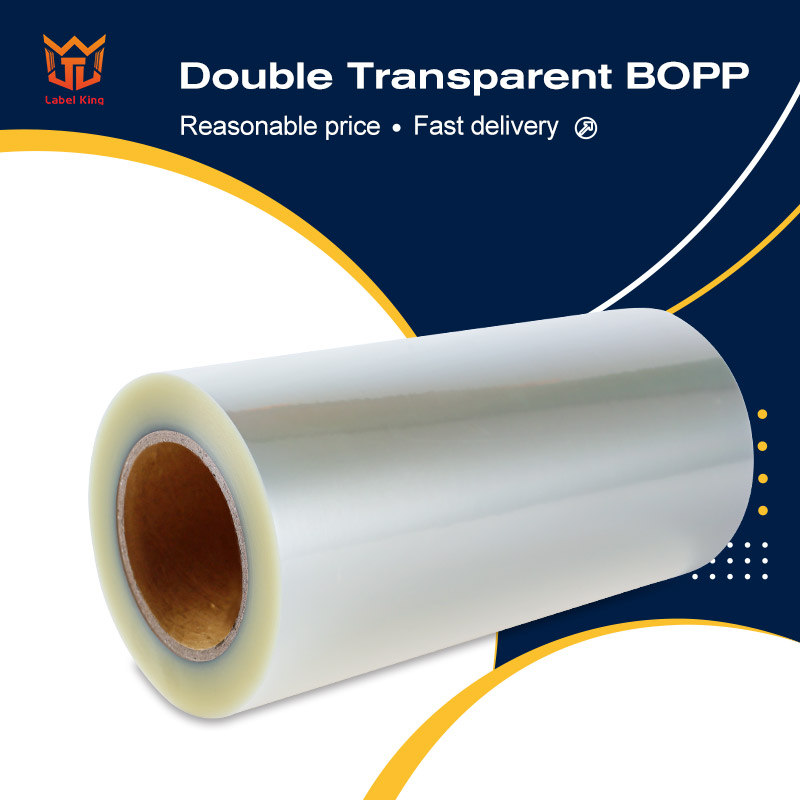
Industry professionals consider this the gold standard for rigid beverage containers. During manufacturing, specialized machines stretch the polymer film in two distinct directions. This biaxial orientation delivers exceptional tensile strength and unmatched dimensional stability. It also creates excellent optical clarity. Transparent BOPP Label Film strongly resists moisture, natural oils, and synthetic chemicals. It performs flawlessly on glass and hard PET bottles. However, you must carefully monitor its rigidity. It remains completely unsuitable for highly squeezable containers.
Polyethylene acts as the primary alternative when you need high conformability. Squeezable juice bottles or sport-cap waters demand flexible packaging. PE stretches and moves easily with the container wall. However, this flexibility demands a distinct physical trade-off. Polyethylene naturally possesses lower transparency and much higher base haze levels compared to BOPP. You will not achieve a perfectly glass-like finish.
Polyester films serve as specialized options for extreme durability. They offer immense high-temperature resistance and dimensional stability. You might use PET for products undergoing hot-fill processes or rigorous pasteurization. Be acutely aware of the higher price point. Packaging experts generally consider PET over-engineered and financially unnecessary for standard cold-chain beverages.
Material Type | Physical Flexibility | Optical Clarity | Moisture Resistance | Ideal Beverage Application |
|---|---|---|---|---|
Transparent BOPP | Low (Highly Rigid) | Very High (Low Haze) | Excellent | Glass bottles, hard PET water bottles, kombucha |
Polyethylene (PE) | High (Squeezable) | Moderate (Higher Haze) | Good | Squeezable juice bottles, sport drinks |
Polyester (PET) | Low (Very Rigid) | Very High (Low Haze) | Excellent | Hot-fill beverages, pasteurized liquids |
A standard clear label rarely delivers a truly invisible look. You must explicitly specify a "clear-on-clear" construction to your converter. This premium construction entails three distinct functional layers. You need a clear face stock, an optical-grade clear adhesive, and a clear PET release liner. Evaluators measure clarity using a metric called "haze percentage." The American Society for Testing and Materials (ASTM) provides specific industry guidelines (ASTM D1003) for testing light transmission. Surface smoothness directly impacts this light transmission. Any microscopic texture on the adhesive scatters ambient light and instantly increases the haze percentage.
Label Construction Type | Average Haze Percentage (%) | Visual Result on Clear Container |
|---|---|---|
Standard Clear Film + Paper Liner | 4.0% - 6.0% | Slightly frosted or textured appearance |
Clear Film + Standard PET Liner | 1.5% - 3.0% | Highly clear, minor edge visibility |
True Clear-on-Clear Construction | < 1.0% | Flawless "no-label" glass-like finish |
Your adhesive choice dictates overall performance in harsh environments. Converters generally offer acrylic-based or hot-melt adhesive chemistries. Acrylic adhesives serve as the undisputed standard for clear labels. They provide superior UV resistance and exhibit almost zero yellowing over time. Specialized hot-melt options exist for highly textured surfaces, but they typically fail strict optical clarity tests.
You must specifically address the dreaded "water whitening" effect. Ice baths and heavy condensation attack standard adhesives relentlessly. Moisture absorption turns the clear layer completely opaque. You must specify adhesives formulated specifically to resist water whitening. Engineers design these formulations to block water molecules from penetrating the polymer matrix. They maintain their flawless optical clarity even after prolonged submersion in retail ice buckets.
Ink needs a highly receptive surface to cure properly. Manufacturers measure this physical receptivity in dyne levels. Surface energy must reach specific thresholds (typically 38-42 dynes) to ensure proper ink anchorage. Untreated films cause expensive ink to bead up or flake off easily. We strongly recommend specifying pre-top-coated films. Top-coating guarantees seamless compatibility with modern flexographic and high-speed UV inkjet printing presses. It completely eliminates the dangerous need for inline corona treatment during the complex converting process.
The release liner acts as the unsung hero of the "no-label look." Glassine liners are highly cost-effective and perfectly fine for standard white labels. However, glassine consists of densely packed paper fibers. These rough fibers imprint microscopic textures directly into the sensitive adhesive layer. When you apply the label, these hidden micro-textures scatter light and create a slightly frosted appearance. PET liners solve this issue entirely. A smooth plastic PET liner allows for perfect adhesive "wet-out." It leaves a completely flat, glass-like finish critical for flawless clear-on-clear results.
High-speed automated bottling lines apply immense physical stress to packaging materials. The dispensing web pulls materials at extreme velocities around sharp angles. The inherent physical rigidity of BOPP prevents frustrating web breaks. It glides smoothly over sharp peel plates without stretching or tearing. Flexible films often elongate under this same tension, causing serious print distortion and misaligned label placement.
You cannot ignore your actual bottling facility conditions. You must accurately match the label's "minimum application temperature" (MAT) to your physical environment. Applying labels to cold, wet bottles requires entirely different chemistry than dry, room-temperature bottles. Condensation on a glass surface creates a hostile moisture barrier. The adhesive must push through this thin water layer to aggressively bond with the container.
Verify your facility's ambient temperature exceeds the material's minimum application temperature.
Ensure the web tension control systems on your applicator are accurately calibrated for BOPP rigidity.
Use high-velocity air knives or wipe-down stations to remove excessive condensation from bottles before application.
Inspect the dispensing peel plate angle to ensure smooth separation from the rigid PET liner.
Calibrate applicator squeegees to provide uniform pressure, eliminating trapped air bubbles.
Consumer safety protocols demand strict attention. Even though a label sits entirely on the outside of a container, chemical migration risks still exist. Volatile chemicals can migrate right through thin plastic container walls over time. You must specify FDA or EFSA compliant adhesives if your application presents any potential migration risk. Regulatory bodies always treat the primary container as a secondary barrier, never a perfect, impenetrable shield.
Sustainability heavily influences all modern packaging decisions. Recycling PET bottles becomes highly problematic when they carry standard BOPP labels. During the industrial recycling wash process, standard adhesives do not release their grip. The BOPP film hopelessly contaminates the pure PET plastic flakes, degrading the recycled batch.
Industry innovators solved this through wash-off (caustic-soluble) adhesives. These specialized formulations allow transparent BOPP labels to cleanly separate from PET flakes in a high-temperature caustic wash (typically 85°C with sodium hydroxide). The lighter BOPP material securely floats to the top of the tank, while the heavier, valuable PET flakes sink to the bottom. This innovative process adheres strictly to APR (Association of Plastic Recyclers) guidelines. It ensures your premium packaging aesthetics never disrupt the global circular economy.
Choosing the ideal transparent film demands a careful matrix decision. You must balance container type, bottling line conditions, and realistic shelf-life expectations. A premium visual aesthetic quickly loses its commercial value if the material fails in a retail cooler or snaps constantly on the dispensing line. Achieving success requires perfectly aligning the face stock, adhesive chemistry, and release liner into one cohesive, engineered system.
Here are your actionable next steps:
Request unprinted material samples, such as A4 sheets or sample rolls, directly from your packaging supplier.
Conduct rigorous real-world testing on your actual product containers using your standard application equipment.
Simulate typical condensation conditions by rapidly cycling bottles from a commercial refrigerator to a warm, humid room.
Assess the adhesive layer closely for any signs of water whitening, edge-lifting, or tunneling.
Formally approve the material performance before committing capital to a full commercial converting run.
A: Bubbling typically results from container outgassing or improper application. Certain plastic containers release micro-gasses over time, which get trapped beneath non-breathable films. More commonly, the bubbling stems from improper applicator pressure. If your machine's squeegee setup lacks uniform pressure, it traps tiny air pockets during dispensing. Ensure your wipe-down rollers apply firm, even pressure across the entire label surface.
A: No, it is generally unsuitable for highly squeezable containers. BOPP is structurally rigid to ensure smooth high-speed dispensing and excellent optical clarity. When applied to a flexible juice or sport-drink bottle, the constant squeezing causes the rigid BOPP film to sharply wrinkle, crease, or lift at the edges. We highly recommend using a polyethylene (PE) blend for high-flex applications.
A: The primary difference lies directly in the release liner and resulting adhesive smoothness. Standard clear labels often use a paper-based glassine liner. Paper fibers leave microscopic textures in the adhesive, causing slight cloudiness when applied. "Clear-on-clear" labels utilize a perfectly smooth PET plastic liner. This allows the adhesive to cure flat, delivering a flawless, glass-like finish with near-zero haze.
A: The base material cost of transparent and white BOPP films remains highly comparable. However, achieving the true "no-label look" requires upgrading to a specialized clear-on-clear construction. The necessary PET release liner costs slightly more to manufacture than a standard glassine paper liner. This specific liner requirement marginally increases your final unit cost, but it guarantees the premium aesthetic.
