

Views: 0 Author: Site Editor Publish Time: 2026-06-19 Origin: Site


Modern brands aggressively pursue the highly coveted "no-label look" for premium beverage, cosmetic, and household product lines. You want your packaging to look seamlessly screen-printed. This aesthetic allows the liquid inside to serve as the visual hero on the crowded retail shelf. But achieving flawless transparency presents a complex engineering hurdle for production teams. Procurement managers and packaging engineers constantly battle to balance optical clarity against durability. They also need reliable printability and high-speed machine efficiency. Choose the wrong substrate, and you risk silvering, flagging edges, or a cloudy finish under harsh fluorescent retail lights. In this article, we will explore why Biaxially Oriented Polypropylene stands out as the ultimate solution for rigid and semi-rigid containers. You will learn the mechanics behind the material. We will examine how it stacks up against alternative films. Finally, you will discover the critical implementation factors required to execute a perfect transparent label run.
BOPP stands for Biaxially Oriented Polypropylene, a process that stretches the film in two directions for superior tensile strength and clarity.
Ideal for rigid/semi-rigid containers: BOPP excels on glass and rigid plastics (PET/HDPE) but is not recommended for highly squeezable tubes.
Moisture and oil resistance: The inherent properties of BOPP prevent degrading, making it the standard for bath, body, and beverage applications.
Adhesive "wet-out" is critical: Achieving a true clear look requires pairing BOPP with a smooth, optically clear adhesive and an appropriate release liner.
What makes Clear BOPP Label Material so exceptionally unique in the packaging world? The secret lies deep within the manufacturing process. Industrial extruders stretch the raw polypropylene film cross-directionally. They pull it in both the machine direction and the transverse direction simultaneously. This biaxial orientation aligns the internal polymer chains perfectly. It creates extraordinary tensile strength within the microscopic structure of the film. The resulting label vigorously resists tearing, snapping, or stretching during intense automated application processes. You gain massive operational reliability on the bottling line.
Engineers evaluate packaging transparency using two specific optical clarity metrics. They measure haze percentage and light transmission rates. Ultra-clear packaging demands a haze level strictly below two percent. It also requires a light transmission rate exceeding ninety percent. BOPP hits these strict targets effortlessly. Standard paper lacks transparency entirely. Basic plastic films scatter too much ambient light, creating an undesirable milky finish. BOPP provides a true, unobstructed window to your product inside the bottle.
Let us observe real-world moisture and chemical defenses. Refrigerator condensation destroys standard paper labels quickly. Humid shower environments soak unprotected substrates, causing rapid peeling. Spilled essential oils and aggressive cleaning agents dissolve weak topcoats on contact. BOPP inherently resists water, oils, and mild solvents without breaking down. Your branding remains pristine even when consumers leave the bottle in a steamy bathroom. It survives perfectly intact even if harsh household chemicals spill down the side during regular use.
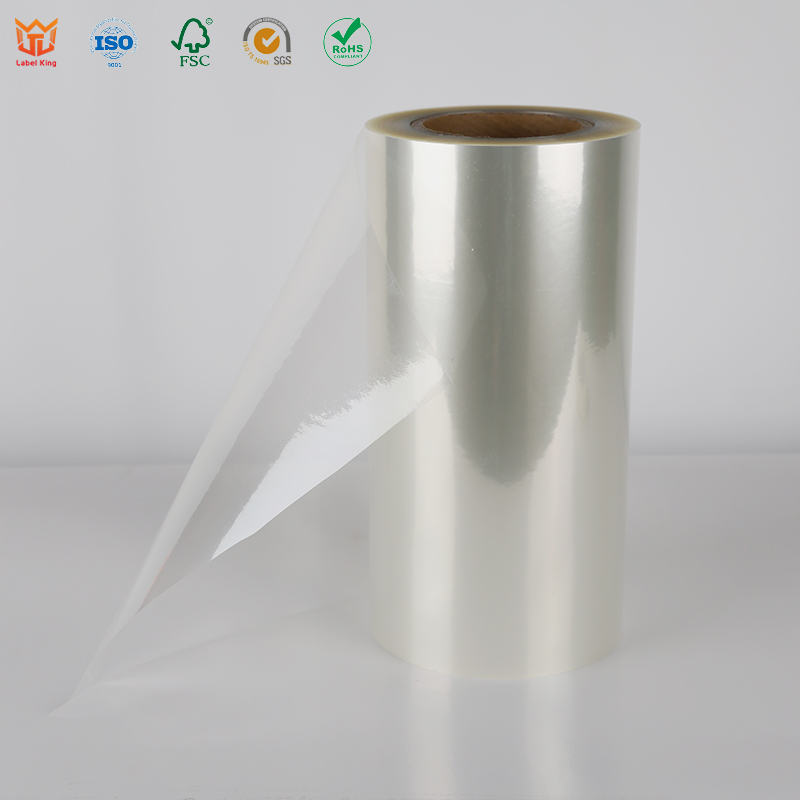
You have multiple film choices when sourcing self-adhesive label materials. The right selection depends entirely on your specific container type and consumer performance demands. We created a direct, decision-focused comparison matrix to help you shortlist the perfect substrate for your next production run.
Material Type | Optical Clarity Level | Physical Flexibility | Best Application Scenarios |
|---|---|---|---|
BOPP (Polypropylene) | Ultra-Clear / Transparent | Low / High Rigidity | Glass, rigid plastics (PET/HDPE) |
PE (Polyethylene) | Slightly Cloudy / Milky | High / Highly Squeezable | Cosmetic tubes, squeeze bottles |
PET (Polyester) | Premium / Glass-like | Ultimate Rigidity | Extreme heat environments, durable goods |
BOPP clearly dominates the beverage and cosmetics sectors. Its primary strengths include excellent optical clarity and high rigidity. This stiffness ensures incredibly smooth auto-dispensing on high-speed applicator lines. You get maximum efficiency at a highly cost-effective price point. However, serious limitations exist. It possesses very poor conformability. You must avoid using it for highly contoured shapes or heavily squeezable tubes. It will simply peel off when flexed.
PE shines strictly in physical flexibility. It acts as the ideal choice for squeezable cosmetic tubes. It moves seamlessly as consumers squeeze the packaging to dispense lotions or gels. Yet, PE has notable design limitations. It delivers lower optical clarity than BOPP. It often appears slightly cloudy or milky under retail lighting. Furthermore, the highly flexible nature means it stretches easily during high-speed machine application, leading to registration errors.
PET offers the ultimate tier of industrial durability. It provides premium, glass-like clarity and exceptional heat resistance. It survives extreme environments effortlessly. But this over-engineering comes at a steep price. It typically registers as the highest cost option among standard films. For everyday consumer goods like bottled water or shampoo, PET acts as complete overkill. It inflates your packaging budgets unnecessarily without adding tangible consumer value.
You cannot achieve a flawless clear label just by buying good film. The adhesive and liner play equally critical roles in the final visual result.
The "wet-out" phenomenon dictates your visual success. "Wet-out" describes how thoroughly an adhesive flows out over a container's surface. To get the perfect "no-label look," the adhesive must lay perfectly smooth against the bottle. Poor wet-out traps microscopic bubbles of air. This failure creates a frosted, silvering, or bubbled appearance underneath the clear film. It ruins the premium aesthetic immediately.
Choosing the right adhesive requires careful chemical consideration. Solvent-based adhesives generally provide smoother, more consistent coats than standard emulsion acrylics. More importantly, emphasize UV-resistant adhesives when drafting your procurement specifications. Standard adhesives yellow significantly over time when exposed to sunlight. This yellowing completely destroys the transparent aesthetic on retail shelves.
Liner selection determines the smoothness of your adhesive layer. Clear BOPP generally requires a PET (polyester) release liner. You should rigorously avoid standard paper (glassine) liners. Paper liners possess natural micro-textures on their surface. When the adhesive rests against a paper liner, it adopts that rough texture permanently. A PET liner keeps the adhesive glass-smooth. It also prevents loose paper dust contamination from jamming your high-speed bottling machinery.
Finally, you must address surface tension and corona treatment. Inks do not naturally stick to raw plastic. Polypropylene possesses inherently low surface energy. Converters must apply a chemical top-coating or perform electronic corona treatment. Corona treatment uses high-voltage electrical discharges to permanently modify the film's surface tension. This vital step ensures robust ink adhesion for modern flexo, digital, or screen printing processes.
High-speed bottling lines demand strict material tolerances. You must perfectly align your label choices with your existing machinery capabilities.
Dispensing rigidities factor heavily into production speed. Applicators running at hundreds of bottles per minute require stable materials. BOPP’s inherent stiffness offers a massive mechanical advantage here. Flimsy materials wrap around applicator rollers or stretch entirely out of registration. The rigidity of BOPP effectively prevents curling and flagging. The label shoots straight off the peel plate onto the passing container. You achieve perfect placement precision every single time.
You must actively acknowledge container shape limitations. BOPP simply does not stretch over complex dimensional shapes. We strongly warn against using stiff BOPP on bottles featuring sharp tapers or multi-directional compound curves. If you force the material onto an hourglass-shaped bottle, failure is imminent. You risk severe edge lift, aggressive darting, or ugly wrinkling along the perimeter.
Environmental factors during application dictate your success rate. You must closely monitor bottling line climates. Temperature ranges play a massive role in adhesive performance. Applying labels onto freezing cold bottles creates immediate adhesive shock. The adhesive freezes up before it can properly wet out. Condensation on the bottle surface acts as a physical barrier. This moisture causes the label to slide out of position or fail entirely. Keep application environments properly climate-controlled and completely dry.
When you send requests to label converters, vague specifications lead to disastrous results. Use this actionable criteria list to ensure you get exactly what you need.
Never guess the required gauge or thickness. Specify standard industry measurements clearly. Typical clear BOPP runs between 2.0 mil and 2.6 mil. Thinner gauges risk snapping violently on the line. Thicker gauges struggle to bend smoothly around small-diameter bottles.
Automated applicators require precise roll wind directions. You must match the label unwind direction to your specific machinery. Communicate clearly whether the label feeds top-first, bottom-first, left-first, or right-first. A mismatched roll renders an entire production run useless until manually rewound.
Always verify compliance and certifications. If your labels go on food packaging, verify FDA guidelines for indirect food contact. If you package industrial chemicals, request certification proving the film and adhesive resist those specific harsh compounds over prolonged exposure periods.
Here is a quick reference checklist for your next materials order:
Define precise material thickness parameters.
Specify a smooth PET release liner over glassine.
Detail the exact roll unwind direction accurately.
Demand UV-resistant adhesive for retail shelf longevity.
Require certified proof of surface treatment for ink durability.
BOPP remains the undisputed baseline for transparent bottle labels. It provides unmatched clarity, excellent tensile strength, and superior water resistance. As long as your container remains rigid and you specify the correct adhesive and liner combination, it delivers exceptional visual results.
To ensure a successful product launch, take these immediate next steps to validate your setup:
Request unprinted material samples directly from your converter.
Perform physical wet-out testing on your actual empty bottle stock.
Observe the labeled bottles for forty-eight hours to check for edge lifting.
Run a small machine trial before committing to full production volumes.
A: Not recommended. BOPP lacks flexibility and will crease or peel off. PE (Polyethylene) is required for squeezable applications.
A: This is typically an adhesive wet-out issue, application over condensation, or the use of a paper liner instead of a smooth PET liner.
A: BOPP is technically recyclable (Plastic #5), but its impact on the recycling stream depends on the bottle material it is applied to (e.g., BOPP on a PET bottle may require specific wash-off adhesives to avoid contaminating the PET recycling process).
